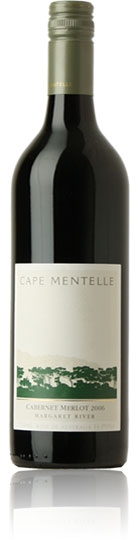
I bought Cape Mentelle on the strong recommendation of various employees of various wine shops and have now tried it on a couple of occasions. I rather like Aussie wines at this price point (£12-15) as they often have great character and are readily accessible, meaning they're a good one to use to introduce a friend/group to wine tasting. With strong flavours that are often comparatively easy to identify along with some occasional subtleties, they nearly always go down well in a blind tasting.
Cape Mentelle is made in Margaret River, in Western Australia. A cool climate, Margaret River is often regarded as one of the top Aussie wine-producing regions, especially for its Cabernet Sauvignons. In due course I will be trying Moss Wood's Cab Sauv, described by Jancis Robinson as 'The Latour of the Margaret River' so I will hopefully be able to build you a picture of the region over the coming weeks or months.
Nose: Immediately obvious are tobacco, cedarwood and some smoke. So far, a very classic Cab Sauv blend. There's fruit at the back of the nose and a hint of pepper. Here's the reason I like these sort of wines as an introduction - plenty of interesting smells that can easily be identified. So far, so good.
Palate: Ah, it's clear we're in Australia now. Lots of rich red fruit hits the palate immediately, with cassis leading the way with some seriously jammy oomph. There is, however, an interesting twist, as the palate suddenly turns dry, with some decent spice and bitterness (coffee, perhaps dark chocolate) coming up to claim the fore. As it develops, the cedar from the nose comes through, clearing off the palate nicely. There's a certain level of astringency to this, but I feel sure that this will fade with some time out of the bottle. Quite a 1-2-3 structure in that the constituent parts are very separate, but this is by no means an unpleasant wine. Eminently drinkable and a crowd pleaser.
Body: I'm sure you can guess from the above that this could only go into the 'full-bodied beast' category, with some serious tannic power to back it up. I wonder if it might be worth leaving it for a year or 3?
Finish: Medium length, fairly basic, but pleasant nonetheless. Nothing worthy of note.
Conclusion: As I noted in the introduction, I'm a fan of this sort of wine. It has good, strong flavours and has clearly been made with a clear purpose in mind. No smoke and mirrors or attempts to beat Bordeaux here, it's Aussie Cab Sauv at its simple best, and it's happy to be it.
Points: 86. At the price, well worth a pop. Interesting enough for a tasting, but would match well with any red meat, ideally a suitably red cut of beef. Yum.
A collection of blind-tasted wine reviews which I hope will provide a helpful (and possibly interesting!) guide to choosing, buying, rating and tasting wine. All comments, criticism, discussion and thoughts are welcome!
Showing posts with label full. Show all posts
Monday, 28 January 2013
Sunday, 27 January 2013
Ataraxia Chardonnay 2009
Anecdotes aside, I have been trying a series of more accessibly-priced Chardonnay from around the world and I stumbled across Ataraxia in September. Ataraxia means tranquillity - a freedom from preoccupation (rather suitable, as it freed several ABCers from their preoccupation with saying ABC). Before I am accused of being intelligent enough to speak Greek, this is helpfully provided on the back of the bottle!
Kevin Friend, the winemaker at Ataraxia (who also have a Sauvignon Blanc and a red, which I can't remember) has made a conscious effort to make Ataraxia a Burgundian-style Chardonnay and has been greatly praised for his excellent work at Hamilton Russell, a particularly fantastic South African vineyard. So, onwards we proceed:
Colour: I tend to think that the colour of the wine is more relevant for whites than reds, as there are only so many ways of saying 'ruby' or 'garnet'. This is a rather appealing rich straw colour, continuing all the way to the edges.
Nose: There is a significant amount of vanilla, confirming the presence of oak (on research, they use 34% new oak and 66% old oak barrels). Along with the vanilla there's a lovely dollop of honey and an almost caramelised smell - perhaps maple syrup? This is a buttery, soft, smooth nose and yet has some real power behind it. Rather strangely there is a slight almost imperceptible hint of chocolate and perhaps some salt as well. I must see if I can confirm that over some more bottles.
Palate: The best bit. After a stellar nose we get everything a person could want with a top Chardonnay: punchy stone fruit is immediately present, smoothed off with vanilla and honey. Indeed, in time the honey becomes even more distinct and the wine becomes exceptionally smooth - almost like drinking a good bit of Highland whisky*. This is really full of flavour and cleans itself off with a dash of minerality and lemon at the end. Accomplished stuff here and clearly marking itself against Burgundy's finest.
Body: This is a heavy and 'thick' Chardonnay. Whilst tasting like some of Burgundy's charmers, it definitely has New World 'oomph'. It's full-bodied with high alcohol but retains its exceptional smoothness.
Finish: Medium to long on the finish. It develops a little, but the majority of the finish comes from a gradual receding of the flavours with yet more honey-vanilla sweetness.
Conclusion: Really really interesting wine. One to try next to a top minerally Burgundy (I think it would be great to try next to a Meursault, but remember that you get what you pay for with Meursault, and should really be aiming for £30+, although LabourĂ©-Roi is an acceptable alternative at £20 or so from Waitrose). It ticks every box and has no unpleasantness about it. Having read my notes through a couple of times, I have now decided to buy a case, as this will certainly improve for several years in the cellar.
Points: 93. At £20 a bottle with excellent cellaring potential, what are you waiting for?
*As a side note on whisky, Highland Park 12 is my 'basic expression' tipple of choice. Lovely honey and vanilla aromas that are reminiscent of this! Extremely smooth. In fact, I shall post a review of that next.
Labels:
ABC,
Ataraxia,
Burgundy,
chardonnay,
full,
honey,
Kevin Friend,
mineral,
peach,
South Africa,
Toastbongo,
vanilla,
white,
Wine
Glenelly Lady May 2008
Hello all, after a brief hiatus due to various work commitments, we're back to South Africa for this post. Glenelly is a South African vineyard with a rather intriguing 'twist'. It's owned by none other than Madame de Lencquesaing, the former owner of the exceptional 'super second' Chateau Pichon Longueville Comtesse de Lalande, who feels South Africa's soils, grapes and climate provide a perfect canvas for Bordeaux-style winemaking. If you have read one or two of my other posts, you'll know it's clear that I also subscribe to this opinion!
As Madame de Lencquesaing's first name is May, the name of this wine provides us with a fairly strong clue as to what to expect. A Bordelais statement in a New terroir, so certainly something different from the usual meaty smokiness that I love so much in South African Cabernet Sauvignon blends. If I remember correctly from the back of the bottle (now in the recycling somewhere in climes unknown), the statue on the front of the bottle is a very young version of Lady May herself! So, onto the wine - decanted for 2 hours and tasted again after 4.
Colour: I felt the need to include a colour section for this wine in particular (as I haven't bothered doing it for other wines so far) because it really is quite extraordinary. I removed the cork and there was almost no colour to it - a rather pale pink that I would associate with Burgundy rather than a heavy Cab Sauv - so I was extremely surprised when I poured out an almost black wine. It is incredibly deep and almost entirely opaque. Quite intriguing that it stained the cork so little. If someone knows how/why this is I would appreciate a comment about it!
Nose: Whoomph. There is an almost overpowering aroma of coffee. There is a hint of hay and barnyard aromas - a slight sourness that perhaps leads into some intensely dark chocolate. Fruit is not overly evident and was not overly evident on later tasting. This, I believe, is where the fact that the wine is so young has had its effect. That's not to say that the nose is closed, as it is certainly not, it is simply that it is currently slightly unbalanced and I look forward to seeing the effect of some time on the bottle (although 10 years may be too long to wait!). There's some real heat in this nose - reminiscent of chilli chocolate (Montezuma Chocolate make it and it's quite intriguing!). In sum: Coffee, hay, dark dark chocolate and some chilli and heat at the end.
Palate: At the first taste I noted massive coffee backed by 'solid' fruit - the fruit, however, was tight and restrained. This, I am sure, is the emphasis of Lady May's Bordelais heritage and a conscious move away from South African style to a more Old World effort. The bitterness of the coffee and dark chocolate definitely comes through near the end, but there isn't harshness to it, so it's not a negative point. On the later tasting (4 hours decanted) I got blackcurrant coming to the fore with the coffee moving to a supporting role (but a rather loud supporting role!). After 5 hours the coffee began to calm down a little, encouraging me to keep trying it.
Finish: As above, fading away into more savoury aromas. A hint of leather coming through (perhaps the evolved version of the slightly sour hay and barnyard aromas in the nose?), coffee and a touch of blackcurrant, but it's elusive.
Conclusion: It must be remembered that this is a VERY young wine and intended to be cellared for a good few years before drinking, so this review will most certainly be coloured by the fact that I am drinking this young. As a result, I find it extremely hard to give it a rating as I don't think it will be a fair analysis. I found this wine extremely interesting, but was it really a wine I would drink? I think that it's only fair to wait for at least another 2 years before drinking and ideally 5 or 10. Given all of the expertise that has gone into it, it's certainly an accomplished wine and it is certainly making a statement. I had a heated debate with a reviewer who referred to this as 'typically South African' that divided the room, but I stand by my view that this is a Bordelais wine residing in a South African terroir.
Points: Anything from 85-91.
I would love to hear if anyone else has tried this and what their feelings were! Next time I will do an overnight decant and see what it's like in the morning.
Labels:
cabernet sauvignon,
chocolate,
coffee,
full,
Glenelly,
hay,
Lady May,
leather,
red,
review,
savoury,
sour,
South Africa,
Toastbongo,
Wine
Subscribe to:
Posts (Atom)

